Darwin to Broome: Five Decisions Before the Long Middle
On a map, Darwin to Broome is one line across the top of the country. On the ground it is a sequence of decisions that each narrow the next one: which season you travel in, what your vehicle is permitted to do, how much water you carry, and where you are allowed to stop. Get the order wrong and the trip gets expensive in ways that have nothing to do with money.
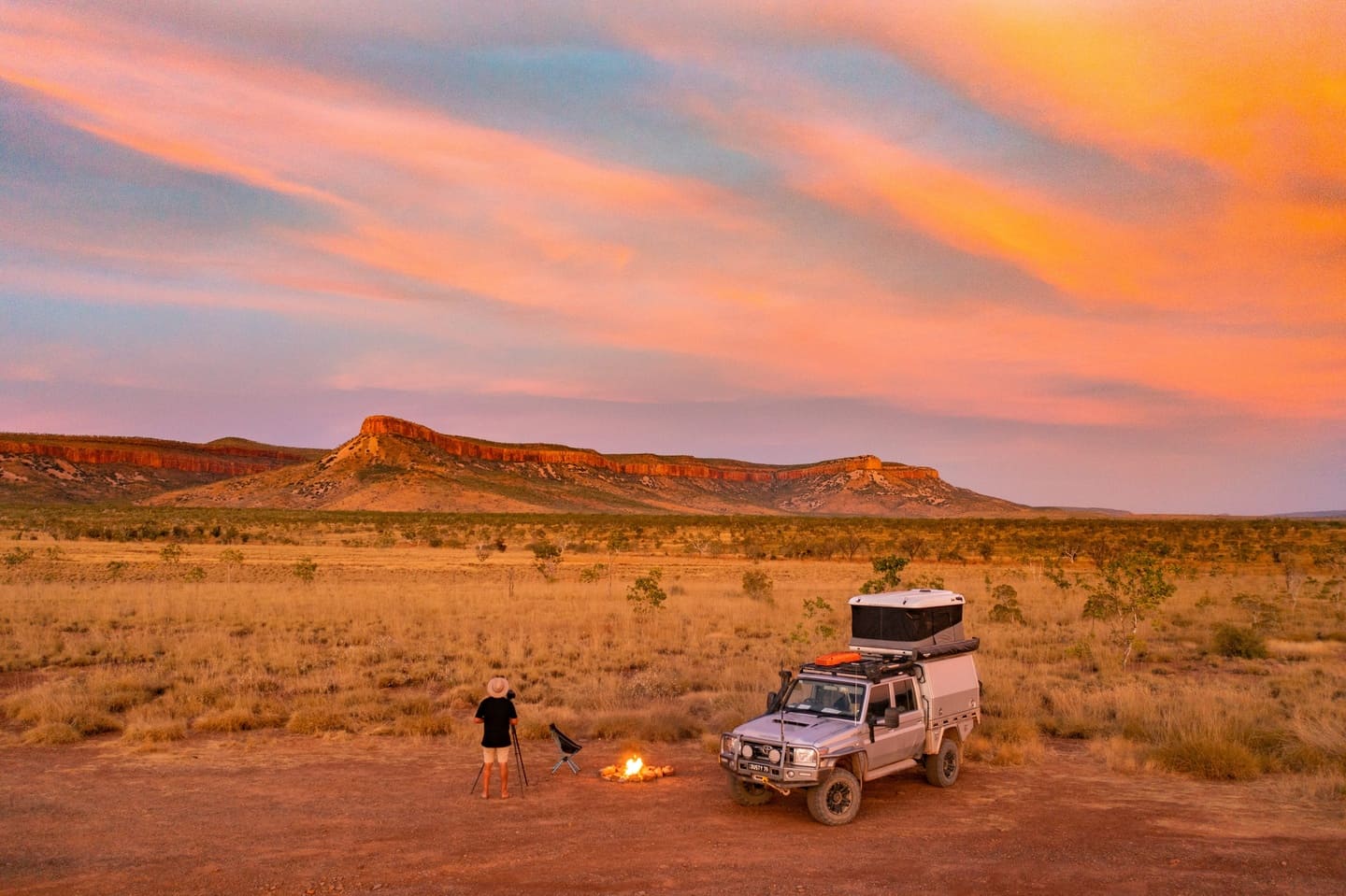
The mistake is planning it as a list of stops
Most route guides for this drive are built the same way: a string of places, in order, with a suggested number of nights. It reads well and it fails in practice, because the places are the least fixed part of the trip. What actually determines whether the drive works is decided before you leave: which season you are in, what the vehicle is allowed to do, how self-sufficient you are, and where you have permission to sleep.
So this is not a stop-by-stop itinerary. It is the five decisions in the order they need to be made, because each one removes options from the next. Pick the wrong season and the vehicle question becomes moot. Pick the wrong vehicle and half the map becomes decoration. Leave the water question until you are already out there and it stops being a planning question at all.
The reason this drive punishes improvisation more than a coastal one is distance between services. On the east coast, a wrong turn costs an hour. Up here, the gap between one place to refill and the next is the thing that structures the day, and it does not care how confident you felt in Darwin.
The season decides everything else
The tropical north has two working seasons and a period between them, and the difference is not cosmetic. Heat, humidity, water crossing the road and the condition of unsealed surfaces all change across the year, and so does what is open at the other end. A plan built for one part of the year can be unsafe or simply impossible in another.
What matters for planning is that closures and conditions are published by the bodies that manage them, not by whoever wrote the guide you are reading. That applies to national park access, to campground openings, and to the roads themselves. Before you lock in dates, check the current status with the parks agency for the jurisdiction and with the road authority for the route, and check again in the week before you go rather than the month before.
Permission, not capability
This is the decision that separates two entirely different holidays, and it is not really about capability. It is about permission. A road may be legally open to one class of vehicle and closed to another, and a rental agreement may exclude a road that the road authority considers perfectly passable. Both of those can be true at once, and the stricter one is the one that applies to you.
The practical consequence is that you should settle the vehicle question against a specific list of roads rather than against a general impression of what the van can handle. Write down the places you actually want, find out what each one requires, then check the rental conditions and the road authority's current advice. If a place on your list fails either test, it comes off the list now rather than at a junction with no signal.
| Question | Who publishes the answer |
|---|---|
| Is this national park campground open, and do I need to book? | The parks agency for that state or territory |
| Are there entry fees or park passes for where I am going? | The parks agency for that state or territory, on its fees page |
| Is this road open, and to what? | The state or territory road authority |
| Is my vehicle allowed on this road under the rental agreement? | The rental operator, in the conditions |
| Is this free camp actually legal to sleep at? | The local council or the land manager |
Who to ask, and about what
That last row is where a lot of confident advice goes wrong. A clearing beside a road, a track to a river, a gravel patch that clearly gets used: none of that is permission. Legality sits with whoever manages the land, and it varies from one council area to the next even along the same stretch of coast.
A small van is a discipline, not a limitation
A two-person camper changes this route in ways that are mostly about what you stop needing. Less storage means you carry one crate of food rather than three, which means you shop more often, which means you are in towns more often, which on a drive like this is a feature rather than a cost. The constraint and the plan are the same thing.
What the van genuinely restricts is carrying capacity for water and for the things that make a long stop comfortable. That is worth planning around rather than resenting. Decide early whether your nights will be in campgrounds with a water supply or in places you have to be entirely self-sufficient for, because it changes what you pack and it may change your route.
- Assume every container you carry will be full at some point, and work out the weight before you fill it.
- Keep one bag for clothes and one crate for food, and refuse the third of either.
- Decide food around what keeps without refrigeration, not around what you would cook at home.
- Carry the small spares that stop a day: a hose fitting, a funnel, a spare strap, a torch you can find in the dark.
- Leave the roof space empty until you know what you actually needed on the first three days.
Water and fuel are one question, asked twice
On a coastal drive, fuel is a habit. Here it is a calculation, and the same calculation applies to water. The two are linked because both are about the distance to the next reliable source and your tolerance for being wrong about it.
The working rule is to never plan to arrive at the last possible refill with the last possible margin. Treat the halfway point as the place to top up rather than the place to start worrying, and treat an unknown supply as no supply until someone on the ground confirms it. Local advice is worth more than a published list here, and the place to ask is the roadhouse, the campground or the visitor centre you are standing in, not a forum thread from three years ago.
The same logic applies to time. A day that looks generous on paper assumes no stops, no roadworks, no wildlife on the road at dusk and no conversation with anyone. Build the day around arriving before dark rather than around covering a number, and the drive stops being a series of deadlines.
Where you are allowed to sleep
Camping rules are the part of this drive most often learned the hard way, because the rules are set by several different bodies and none of them publish a single national list. National park campgrounds, state-managed reserves, council land, pastoral leases and private stations all have different answers to the same question, and the answer can change with the season.
Camping inside national parks is managed by the parks agency for the jurisdiction you are in: in the Northern Territory by NT Parks and Wildlife, in Western Australia by the state parks service. Each publishes its own booking arrangements and its own entry and camping fees, and those pages are the only ones worth relying on. Neither system tells you anything about free camping on council land, which is a local decision and needs a local check.
The habit worth building is to confirm tonight's stop before lunch, not at four in the afternoon. That single change removes most of the bad decisions on this drive: the late arrival at a full campground, the hopeful pull-off that turns out to be private land, the long push to a place that closed for the season last month.
What the drive is actually like
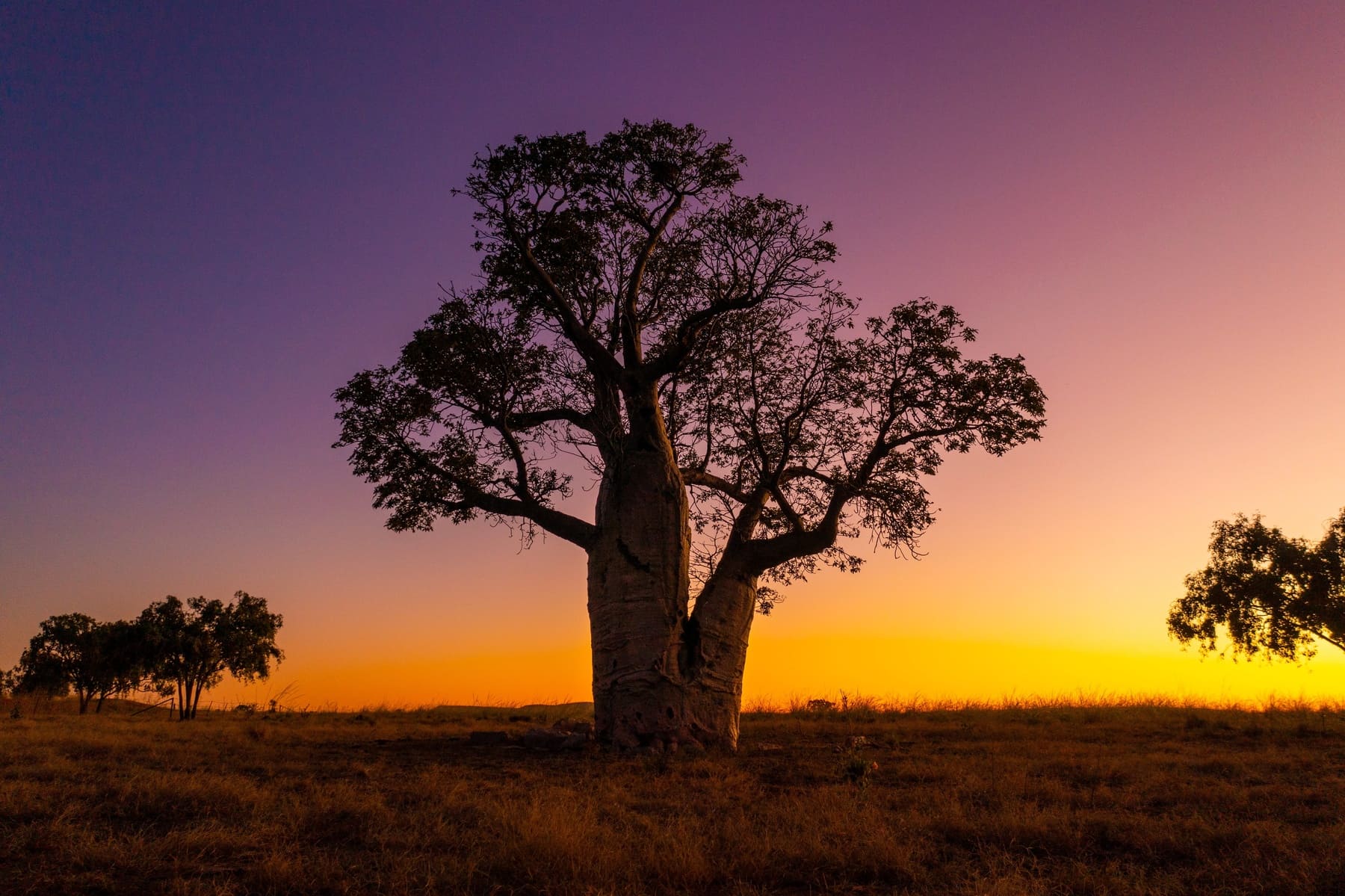
Between the decisions, this is a road of long horizons and abrupt changes of register. Savannah woodland with a single baobab standing against a sunset, then a red escarpment that appears out of flat country and takes an hour to pass. The distances between those moments are the trip. There is no shortcut through them and no viewpoint that substitutes for the driving.
That is the argument for giving it more days than the map suggests. A small van makes the long middle tolerable because the long middle is where you sleep, cook and sit, and it makes it better because a short vehicle is easier to turn around in when the thing you wanted to see turns out to be twenty minutes back. Both of those advantages are wasted if the schedule leaves no room to use them.
Questions people ask
- What is the hardest part of planning Darwin to Broome?
- The order of the decisions rather than the route itself. Season first, then what the vehicle is permitted to do, then how self-sufficient you will be, then where you may sleep. Each one removes options from the next, so making them out of order means redoing the plan. The stops are the easy part and the least fixed part of the whole exercise.
- Do I need to book campsites in national parks on this route?
- Bookings are handled by the parks agency for the jurisdiction you are in, and the Northern Territory and Western Australia run separate systems. Rather than assume you can turn up, find the agency page for the specific campground and check its current booking arrangements, opening status and fees. Rules can change with the season, and some sites close or change status partway through the year, so confirm before you rely on a stop.
- Can a two-person campervan do this drive?
- That depends on the specific roads, not on the drive as a whole. Vehicle permissions are set per road, and a rental agreement can exclude a road that is legally open. Settle it against a written list of the places you want to reach, then check both the road authority's current advice and the operator's conditions. Anything that fails either check comes off the list before you leave.
- How much water should I carry?
- Enough that running out is not a possibility rather than a risk. Work out how many days you will be between reliable supplies, then treat an unconfirmed supply as no supply. Ask at the last town before a long section whether the next supply is open and reliable, and carry more than the answer suggests. Water is also the reason to decide your campground nights before you pack.
- When should the driving day end?
- Before dark, and earlier than feels necessary. Long days here assume no stops, no roadworks and no wildlife on the road at dusk, and all three happen. Build each day around arriving with light left to set up and cook, not around a distance target. It also means you can change your mind about where to stop without the decision being made for you by the light.
Where these facts come from
- NT Parks and Wildlife — camping and campgrounds
- NT Parks — parks booking system
- Parks and Wildlife Service WA — park entry fees
- Parks and Wildlife Service WA — camping
- Campervan hire Darwin
- Campervan hire Broome
Details like booking rules, fees and closures change. Check the authority above before you rely on any of it for a specific date.